

Mission
The mission of the Manship School is to produce highly competent communicators with broad knowledge and training in the liberal arts and the media. The school promotes effective communication, critical thinking, and ethical responsibility. Through its teaching, research, and public service, the school is committed to leading the study and practice of media and public affairs. Believing that media should reflect and provide leadership to society, the school seeks a range of perspectives in its outlook.
Communication is Our Passion
At the Manship School, students and faculty know each other by name and work closely together. Students find a dynamic place to build the skills they need to work as professionals in media and communication. Through our teaching, cultivation and application of knowledge, we educate creative thinkers and future leaders in journalism, advertising, public relations and political communication and are committed to leading the study and practice of media and public affairs in an evolving technological and global society.

21st Century Communicators
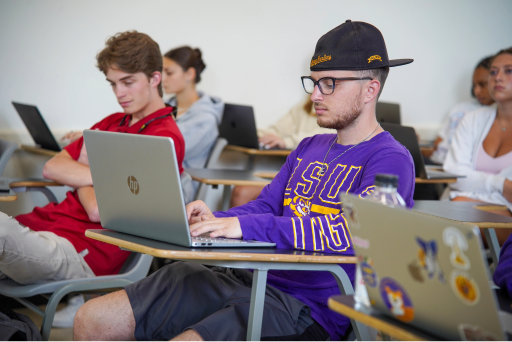 While other mass communication programs scramble to keep up with a rapidly changing
media landscape, we are taking steps to prepare all students to succeed on every platform
– digital, broadcast, print, social media and whatever comes next. The Digital Media
Initiative is part of the Manship School’s goal of bringing innovative thinking about
the digital environment to the forefront of its educational curriculum. The Social Media Analysis and Creation (SMAC) Lab in Hodges Hall is an open, collaborative workspace that brings together students,
faculty and industry professionals to study and shape the future of mass communication.
Within the lab, participants work together to create digital, social and mobile platforms
while examining their impact on audiences. Designed as both a creative and research-focused
environment, the space encourages collaboration and experimentation, featuring walls
covered in dry-erase paint and an internet-enabled, web-conference–ready television
equipped with Google TV and Apple TV.
While other mass communication programs scramble to keep up with a rapidly changing
media landscape, we are taking steps to prepare all students to succeed on every platform
– digital, broadcast, print, social media and whatever comes next. The Digital Media
Initiative is part of the Manship School’s goal of bringing innovative thinking about
the digital environment to the forefront of its educational curriculum. The Social Media Analysis and Creation (SMAC) Lab in Hodges Hall is an open, collaborative workspace that brings together students,
faculty and industry professionals to study and shape the future of mass communication.
Within the lab, participants work together to create digital, social and mobile platforms
while examining their impact on audiences. Designed as both a creative and research-focused
environment, the space encourages collaboration and experimentation, featuring walls
covered in dry-erase paint and an internet-enabled, web-conference–ready television
equipped with Google TV and Apple TV.
We offer four areas of concentration: digital advertising, journalism, political communication and public relations. Students in any concentration may pursue our 3+3 Pre-Law Program, which allows Manship School students to complete both a bachelor’s and a law degree with three years of full-time study at LSU and three years of full-time study at the LSU Law Center. Our goal is to ensure students receive excellent and innovative instruction and academic experiences that meet the school's teaching goals. Assessment is, therefore, a crucial, ongoing process that evaluates student learning at the program level with a focus on cohorts. A detailed plan can be found in our Undergraduate Student Learning Assessment Plan.
 Focus on Media & Public Affairs
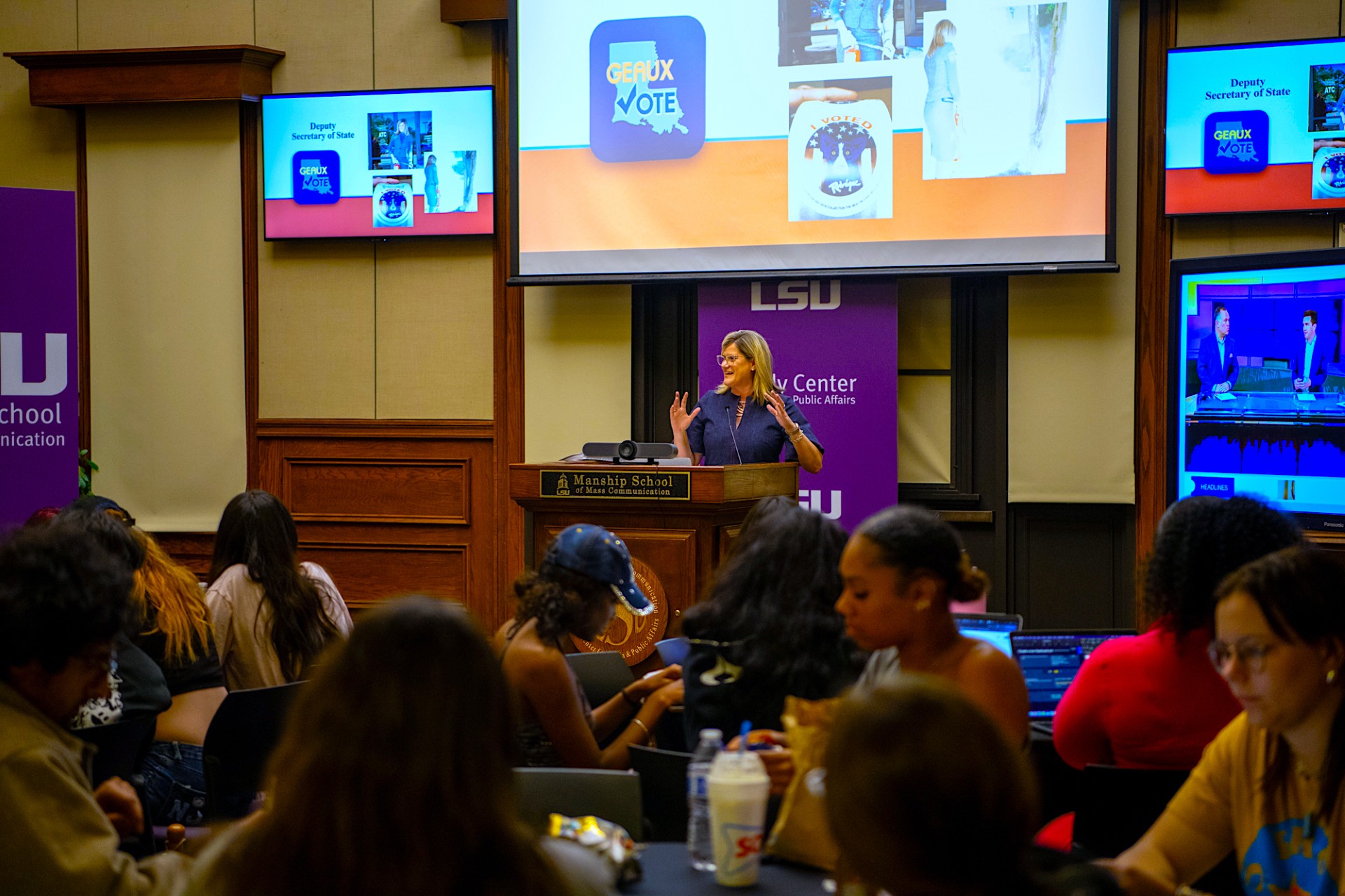
Reilly Center for Media & Public Affairs
Teaching and scholarship at the intersection of media and public affairs–it's our signature emphasis and what distinguishes the Manship School from other mass communication programs. In 1998, the Manship School established the nation's first and only doctoral program specializing in media and public affairs.
The Reilly Center for Media & Public Affairs, an integral part of the Manship School, uses the intellectual muscle of the school’s faculty to help solve practical problems and advance good government initiatives. The Reilly Center’s mission is to generate thoughtful dialogue, research and programming about mass communication and its many-faceted relationships with public policy. Evident in everything the center does is its commitment to strengthen and advance our national leadership in media and politics.
Commitment to Engagement & Community
We are committed to fostering an educational environment where a wide range of perspectives is valued and encouraged. Our goal is to be a leader in educating both students and professionals on the significance of representation in media and in mediated content. The Association for Education in Journalism and Mass Communication awarded its inaugural Award for Equality and Opportunity to the Manship School. We were recognized for our comprehensive plan to promote broad representation, fundraising efforts to support all of our student organizations and groups, organized initiatives to recruit a variety of faculty and students and our ongoing focus on course offerings, faculty research and service to other universities, journalists, and the public through the research and public engagement.
- 60% of our faculty members have conducted research on topics related to representation.
- We have received four separate grants that focus on issues related to opportunity and representation.
- In 2021, 27% of our students and more than 30% of our faculty came from historically underrepresented groups.
- The Reilly Center for Media & Public Affairs helped establish the Forum on Media Representation, which includes an extensive bibliographic database of academic and professional journal articles, books and conference papers on representation issues, with a focus on media, journalism and communication in both national and international contexts.