
Upcoming Events
Bayou Arithmetic Research Days
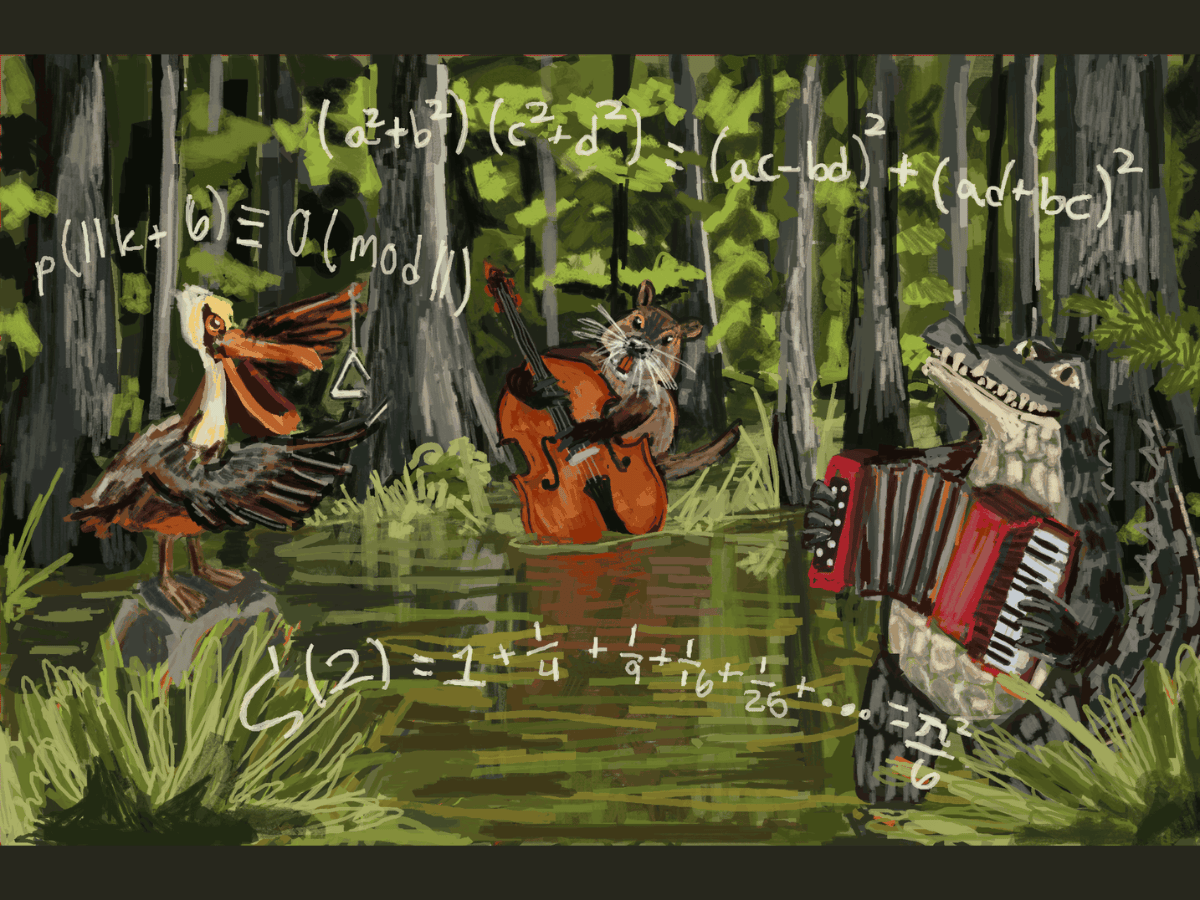
Bayou Arithmetic Research Days (BARDs) are one-day number theory mini-conferences bringing together students and researchers from across the Gulf Coast region. Held approximately twice a year at Louisiana universities, BARDs feature distinguished research speakers while creating opportunities for graduate students and early-career mathematicians to present their work, exchange ideas, and build regional collaborations.
November 20, 2026
Mathematical Analysis of Electronic Phenomena in Quantum Materials
This workshop brings mathematicians and physicists together around electronic phenomena in quantum materials and the mathematical structures needed to describe them. Topics include spectral theory, singular spectra, continuum and moiré models, incommensurate systems, topology, defect states, and the relation between rigorous analysis and physical modeling.
January 4-8, 2027
ASPIRE Workshop | AI Opportunities in Science: Partnerships, Interdisciplinary Research and Education
The program begins by mapping current AI activity across LSU and then moves into speed-research sessions where participants share questions, identify complementary expertise, and form new interdisciplinary connections.
February 19-20, 2027Bayou Arithmetic Research Days
Bayou Arithmetic Research Days (BARDs) are one-day number theory mini-conferences bringing together students and researchers from across the Gulf Coast region. Held approximately twice a year at Louisiana universities, BARDs feature distinguished research speakers while creating opportunities for graduate students and early-career mathematicians to present their work, exchange ideas, and build regional collaborations.
November 20, 2026Mathematical Analysis of Electronic Phenomena in Quantum Materials
This workshop brings mathematicians and physicists together around electronic phenomena in quantum materials and the mathematical structures needed to describe them. Topics include spectral theory, singular spectra, continuum and moiré models, incommensurate systems, topology, defect states, and the relation between rigorous analysis and physical modeling.
January 4-8, 2027ASPIRE Workshop | AI Opportunities in Science: Partnerships, Interdisciplinary Research and Education
The program begins by mapping current AI activity across LSU and then moves into speed-research sessions where participants share questions, identify complementary expertise, and form new interdisciplinary connections.
February 19-20, 2027
Applied Mathematics of Complexity, Nonlocality, and Uncertainty in Extreme Material Response
This meeting connects difficult questions in material response under extreme conditions with mathematical tools for nonlocality, complexity, uncertainty, and multiscale behavior. Themes include nonlocal PDE and integro-differential models, peridynamics, phase-field and variational methods, uncertainty quantification, numerical analysis, and structure-preserving scientific machine learning.
Tentative: March 8-12, 2027
Harmonic Analysis at the Interfaces of Arithmetic, Geometry, and Frames
A training-centered harmonic-analysis meeting connecting arithmetic and geometric structure with frames, oscillatory methods, and neighboring areas. Mini-courses and focused research talks will give graduate students and researchers from adjacent areas structured entry points into the meeting.
Tentative: March 11-14, 2027Applied Mathematics of Complexity, Nonlocality, and Uncertainty in Extreme Material Response
This meeting connects difficult questions in material response under extreme conditions with mathematical tools for nonlocality, complexity, uncertainty, and multiscale behavior. Themes include nonlocal PDE and integro-differential models, peridynamics, phase-field and variational methods, uncertainty quantification, numerical analysis, and structure-preserving scientific machine learning.
Tentative: March 8-12, 2027Harmonic Analysis at the Interfaces of Arithmetic, Geometry, and Frames
A training-centered harmonic-analysis meeting connecting arithmetic and geometric structure with frames, oscillatory methods, and neighboring areas. Mini-courses and focused research talks will give graduate students and researchers from adjacent areas structured entry points into the meeting.
Tentative: March 11-14, 2027